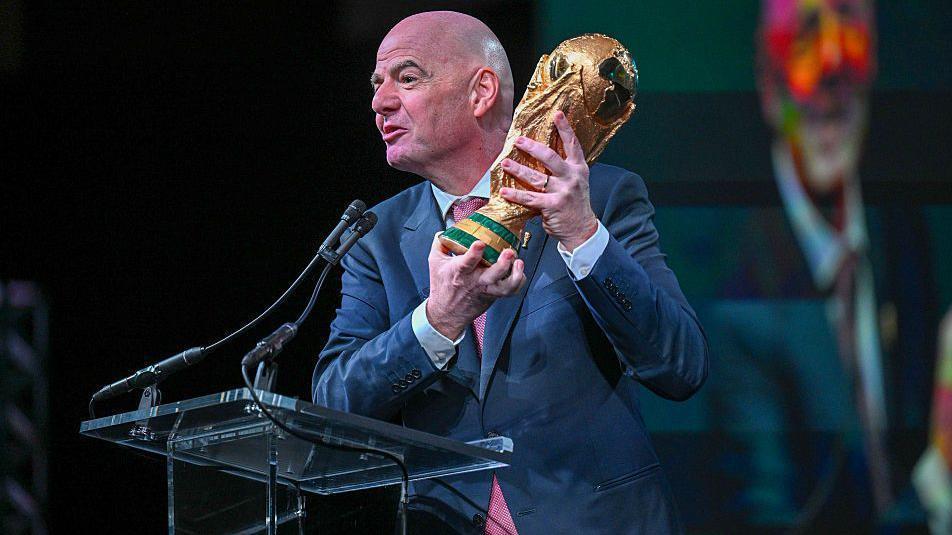
World Cup 2026: Will Gianni Infantino push for tournament 64
July 22, 2026 · ArgentinaPerúItaliaPortugal
This article discusses the potential expansion of the 2026 World Cup to 64 teams under the leadership of Gianni Infantino, as well as the resulting implications regarding competition, logistics and financial motivation.
World Cup 2026: Will Gianni Infantino push for 64 tournament
According to News.
Background
Cape Verde, despite being a small country, has shown the potential to compete at a high level in football. With the possible expansion of the 2026 World Cup, Cape Verde and other smaller teams could see new opportunities to participate in this prestigious tournament, which could raise their football profile globally.
Why this is important
The expansion of the 2026 World Cup to 64 teams under the leadership of Gianni Infantino could provide an opportunity for small countries like Cape Verde to compete on the international stage. It also reflects a change in FIFA's philosophy to focus on inclusivity and global football development. With more teams participating, it is hoped there will be an increase in the quality of the competition and appeal to football fans around the world.
Main Points
- World Cup 2026: Will Gianni Infantino push for 64 tournament.
- This article discusses the potential expansion of the 2026 World Cup to 64 teams under the leadership of Gianni Infantino, as well as the resulting implications regarding competition, logistics and financial motivation.
- World Cup 2026: Could Gianni Infantino push through a 64-team tournament? - BBC Sport
In Gianni Infantino's decade as FIFA President, it has become clear that more is better. That could mean more tournaments, more matches, and of course, more money. From changes to the format of the Club World Cup to the upcoming expansion of the World Cup, Infantino doesn't seem to want to stop. Now, he has opened up the possibility of expanding the World Cup to 64 teams.
Infantino argues that if small countries are not given the opportunity to participate, they will lack incentives to continue developing. However, the reality is that small countries are not actually prohibited from participating. If they are good enough, they can qualify. For example, Cape Verde, Curacao, Jordan and Uzbekistan show that there are opportunities for small teams to compete at a high level.
From a competition format perspective, expanding to 64 teams could provide a more natural structure, where the top two teams from 16 groups would advance to the knockout stages without requiring the third-placed team to continue. However, are there other logical reasons to expand the number of teams?
Let's take a closer look at how we got here. The 2030 World Cup will mark one hundred years since the first World Cup was held in Uruguay. The tournament will be held in Morocco, Portugal and Spain, but the opening three games will take place in Uruguay, Argentina and the commemorative hosts Paraguay. The South American Confederation (Conmebol) requested to hold a 64-team tournament as a way to welcome more participants.
However, support for this plan is minimal. UEFA president Aleksander Ceferin called it a "bad idea" for the tournament and qualification process. Victor Montagliani, President of Concacaf, stated that this could damage the "wider football ecosystem". A similar opinion was expressed by AFC President Sheikh Salman bin Ibrahim Al Khalifa, who warned that further expansion could cause "chaos".
However, the final decision will be taken by the 37 members of the FIFA Council. The question that arises is whether adding more teams will reduce the value of the World Cup itself? Some of the advantages of a 64-team tournament include a more natural format as well as more opportunities for developing countries. Infantino is very supportive of this, especially after Cape Verde's impressive performances in previous tournaments.
However, these success stories need to be balanced with the competitiveness of the tournament. Several teams such as Haiti, Iraq, Jordan, Panama, Tunisia and Uzbekistan failed to get a single point. By adding more teams, it is difficult to imagine top teams like Belgium (2022), Germany (2018), Spain (2014), Italy (2010) and France (2002) not making it to the knockout stages.
Talking about the distribution of additional places, based on this year's qualifications, here are the countries that are likely to qualify if the 2026 World Cup is expanded to 64 teams: from the AFC, Indonesia (ranked 118th), Oman (79th), and the United Arab Emirates (68th); from UEFA, Denmark (21), Italy (12), and Poland (36); from Concacaf, Honduras (65), Jamaica (71), and Suriname (125); from Conmebol, Bolivia (77) and Venezuela (49); from OFC, New Caledonia (151); and from Africa, Burkina Faso (62), Cameroon (44), Gabon (86), and Nigeria (26).
A total of six of these countries are in the FIFA top 50 rankings, indicating that there are some challenges in balancing competition among confederations. Asia and Concacaf, for example, have proven to be weaker based on their teams' performances in previous tournaments.
The expansion of the World Cup also poses logistical challenges. With 64 teams, there will be more matches taking place, and this could extend the duration of the tournament. This year's tournament lasts 39 days, and the addition of 24 games will require more time and schedule slots. Additionally, with climate change affecting the weather, timing matches during the day is becoming increasingly difficult.
For the most part, this expansion seems to have more to do with the financial aspect. One of Infantino's main promises is to bring more money into football, with every football association now getting access to significant funding. In this context, the expansion to 64 teams seems more about monetization than global football development.
What happened next
If these expansion plans come to fruition, teams like Cape Verde will have a greater chance of participating in the World Cup, which could motivate the development of football in smaller countries. Additionally, FIFA will probably formulate more policies to support these teams in qualifying. With the 2026 World Cup fast approaching, attention will be on how this new format will be implemented and its impact on future tournaments.
Frequently Asked Questions
What happens to the expansion plans for the 2026 World Cup?
Gianni Infantino opens up the possibility of expanding the World Cup to 64 teams.
Who confirmed the World Cup expansion plans?
Gianni Infantino, FIFA President, raised this possibility.
Why is there talk now about expanding the World Cup?
Infantino argued that small countries need to be given the opportunity to participate so that they have an incentive to develop.
What are the proposed format changes for the 2026 World Cup?
An expansion to 64 teams could provide a structure in which the top two teams from 16 groups would advance to the knockout stages.
What has been the response to the World Cup expansion plans?
Support for the plan is minimal, with UEFA President Aleksander Ceferin calling it a 'bad idea'.